How CMHC Default Insurance Premiums Work: Understanding Mortgage Insurance When Putting Less Than 20% Down
Buying your first home is exciting, but it also comes with a long list of unfamiliar terms. One of the most misunderstood concepts among Canadian homebuyers is mortgage default insurance.
Many buyers have heard names like CMHC, Sagen, or Canada Guaranty, but aren't entirely sure what they do, why they're required, or how they affect the total cost of a mortgage.
If you're planning to purchase a home with less than a 20% down payment, understanding mortgage default insurance isn't optional—it's essential.
In this guide, we'll explain what mortgage default insurance is, who provides it, how premiums are calculated, why lenders require it, and whether putting less than 20% down is always the right financial decision.
Stage 1: What Is Mortgage Default Insurance?
One of the biggest misconceptions among homebuyers is believing that mortgage default insurance protects them.
It doesn't.
Mortgage default insurance protects the lender, not the borrower.
If a borrower stops making mortgage payments and defaults on the loan, the insurance company reimburses the lender for eligible losses. Because lenders are protected against this risk, they're willing to approve mortgages with much smaller down payments than would otherwise be possible.
Without mortgage default insurance, most Canadians would need at least a 20% down payment before qualifying for a mortgage.
Instead, insured mortgages allow qualified buyers to enter the housing market with as little as 5% down, provided they meet lending requirements.
Stage 2: Meet Canada's Three Mortgage Insurance Providers
Canada has three mortgage default insurance providers:
CMHC (Canada Mortgage and Housing Corporation)
Sagen
Canada Guaranty
All three perform essentially the same role.
Their primary responsibility is to insure high-ratio mortgages (those with less than 20% down payment), allowing lenders to approve financing while reducing their risk.
Although premium rates are generally very similar, each insurer has slightly different underwriting guidelines.
For example, some may be more flexible with self-employed borrowers, while others may have different policies regarding certain property types or borrower profiles.
The important thing to remember is that you don't choose the insurer.
Your lender selects the insurer based on their lending relationship and which provider is most likely to approve your application
Stage 3: Why Some Buyers Get Declined Even After Mortgage Approval
This surprises many homebuyers.
Receiving approval from a lender doesn't always mean your mortgage is fully approved.
When your down payment is under 20%, the mortgage insurer must also approve the application.
Because the insurer is guaranteeing the loan, they carefully review factors such as:
Debt-to-income ratios
Employment stability
Income verification
Credit history
Property eligibility
This additional layer of underwriting means insured mortgages often have stricter qualification standards than borrowers expect.
Working with an experienced mortgage broker becomes especially valuable because they understand which insurers may be the best fit for different borrower profiles.
Stage 4: How Mortgage Insurance Premiums Are Calculated
The cost of mortgage default insurance depends on the size of your down payment.
As a general rule, the smaller your down payment, the higher the insurance premium you'll pay. Conversely, increasing your down payment reduces the premium because you're borrowing a smaller percentage of the home's value.
For buyers putting between 5% and 9.99% down, the premium is generally 4.00% of the mortgage amount.
Once your down payment reaches 10%, the premium drops to approximately 3.10%.
If you're able to put down 15% to 19.99%, the premium is further reduced to approximately 2.80%.
Once you reach a 20% down payment, mortgage default insurance is generally no longer required because your mortgage is considered uninsured.
This means that even a relatively small increase in your down payment could significantly reduce your insurance costs. If you're close to one of these thresholds, it's worth speaking with your mortgage broker to determine whether contributing a little more upfront could save you money over the life of your mortgage.
Stage 5: A Real Example
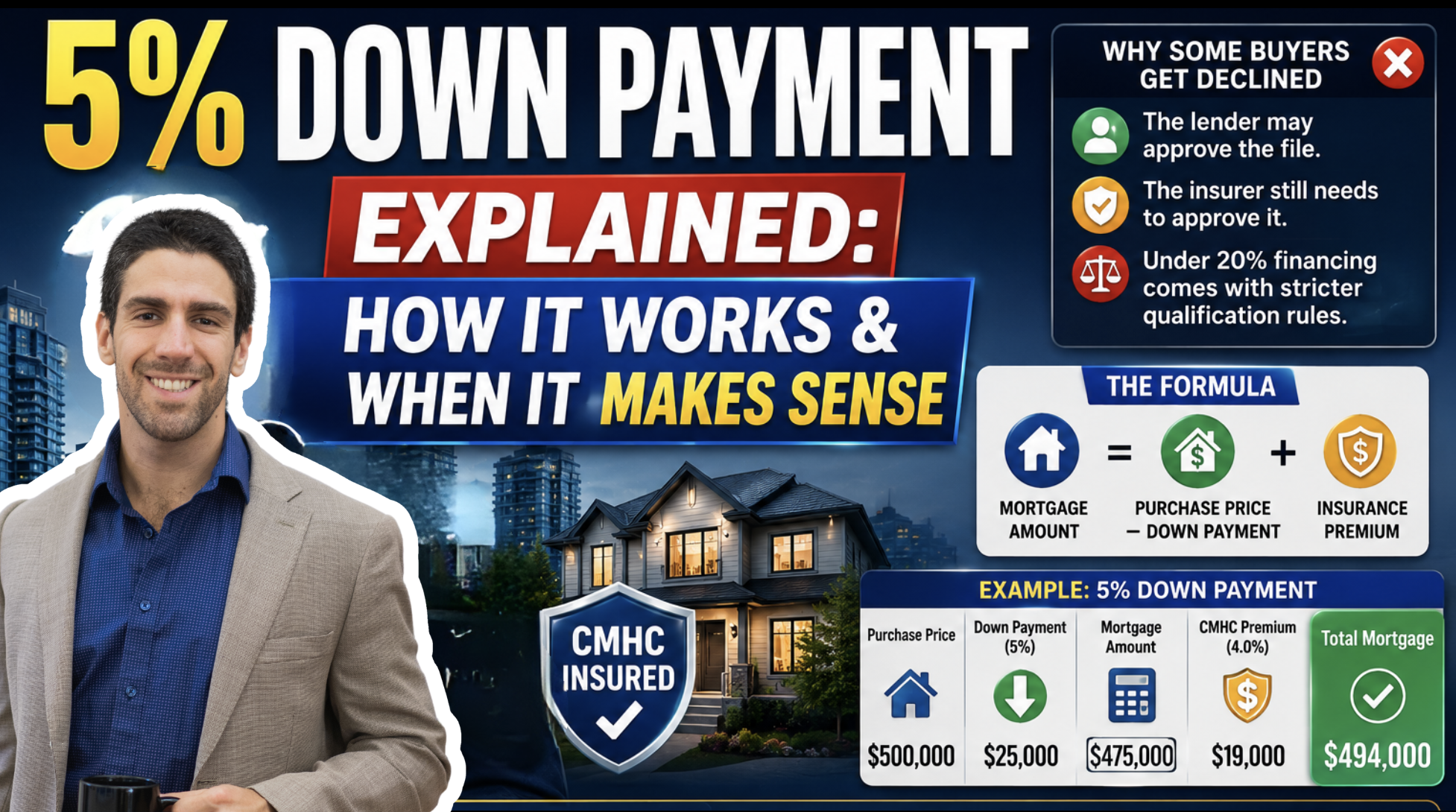
Let's assume you're purchasing a home for $500,000.
You decide to make a 5% down payment, or $25,000.
That leaves a mortgage of $475,000.
If your insurance premium is 4%, the premium would be approximately:
$475,000 × 4% = $19,000
Rather than paying this amount upfront, the premium is typically added directly to your mortgage balance.
Instead of borrowing $475,000, your total mortgage becomes approximately $494,000, and you'll repay that amount over your mortgage amortization period.
Stage 6: Can You Cancel the Insurance Later?
This is one of the most common questions buyers ask.
Unfortunately, the answer is no.
Once your mortgage closes with less than a 20% down payment, the insurance premium becomes a permanent part of that mortgage.
Even if:
Your home's value increases,
You aggressively pay down your mortgage,
Or your equity grows beyond 20%,
the insurance premium is not refundable.
For this reason, your initial down payment decision deserves careful planning.
Stage 7: Is Putting Less Than 20% Down Always a Bad Idea?
Not necessarily.
Many buyers assume they should always wait until they save a full 20% down payment.
In reality, the better decision depends on your financial situation.
Putting less than 20% down may allow you to:
Purchase a home sooner.
Preserve cash for investments.
Maintain an emergency fund.
Benefit from future home appreciation rather than waiting years to save a larger down payment.
There's also an important advantage many buyers overlook.
Because insured mortgages present less risk to lenders, they often qualify for lower mortgage interest rates than uninsured mortgages.
The key question isn't simply:
"How do I avoid mortgage insurance?"
Instead, ask:
"What down payment creates the strongest long-term financial outcome?"
Sometimes that's 20%.
Sometimes it's 10%.
Every situation is different.
Stage 8: Making the Right Down Payment Decision
The ideal down payment isn't necessarily the largest one.
It's the one that balances:
Mortgage affordability
Insurance costs
Investment opportunities
Monthly cash flow
Long-term wealth creation
A thoughtful strategy considers not only today's mortgage payment but also what your money could accomplish elsewhere over the next 20 to 30 years.
That's why working with both a knowledgeable mortgage broker and financial advisor can make a significant difference.
A Broker's Job Goes Beyond Finding the Lowest Rate
A good mortgage broker doesn't simply compare advertised rates.
They monitor market conditions, negotiate with lenders, leverage competing offers, and continuously review your options right up until closing.
Their goal is to make sure you're getting the strongest combination of:
Competitive pricing
Flexible mortgage features
Low penalties
Long-term financial value
The best mortgage isn't simply the cheapest today—it's the one that saves you the most money over the entire life of your mortgage.
Final Thoughts
Mortgage default insurance is often viewed as an added expense, but it's really a financing tool that allows thousands of Canadians to become homeowners years earlier than they otherwise could.
The important part isn't simply understanding what CMHC, Sagen, or Canada Guaranty do.
It's understanding how your down payment affects your insurance premium, your mortgage approval, your interest rate, and your long-term financial strategy.
When you understand how these pieces fit together, you can make decisions based on long-term wealth—not just short-term costs.
The Bottom Line
Buying a home with less than a 20% down payment doesn't automatically mean you're making a poor financial decision. Mortgage default insurance is simply one factor in a much larger financial strategy. The right down payment depends on your goals, investment opportunities, cash flow, and long-term wealth plan—not just avoiding an insurance premium. If you're buying your first home or comparing different down payment options, speaking with an experienced mortgage professional can help you determine which strategy creates the best financial outcome—not just today's lowest payment.
Level Up Mortgages helps entrepreneurs, investors, newcomers, and professionals structure financing around long-term outcomes, not just approvals. Because the best mortgage decision isn't necessarily the one that gets you into a property today, it's the one that creates the most options tomorrow.
See What You Qualify For Or Contact Paul To Get Your Pre-Approval.
Paul Davidescu (www.levelupmortgages.com)
Level Up Mortgages
604-809-3188
paul@levelupmortgages.com
See Our Google Reviews in BC & Ontario: bit.ly/GoogleReviewLUM ⭐️⭐️⭐️⭐️⭐️