
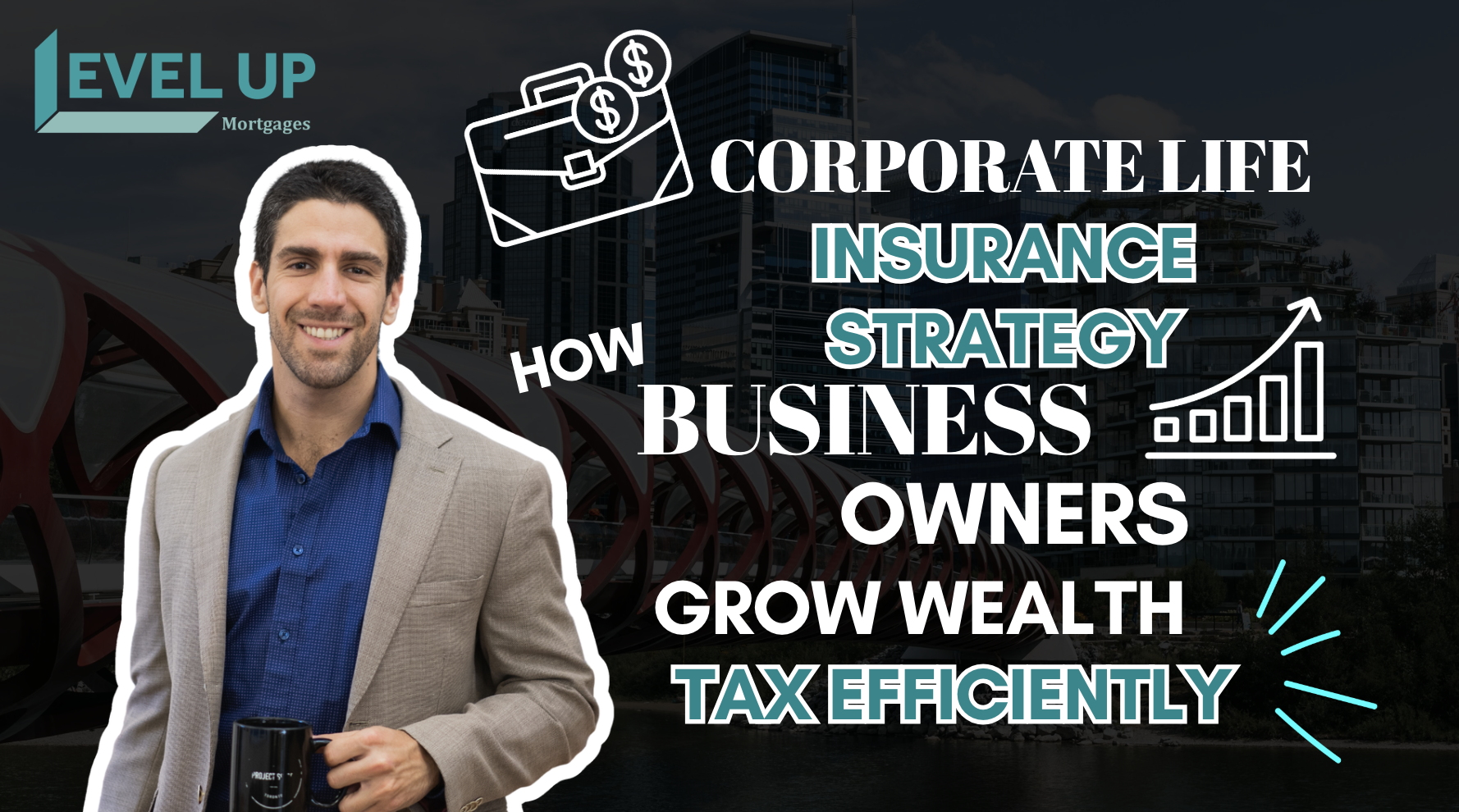
How Business Owners Can Use Permanent Life Insurance to Build Tax-Efficient Wealth
Double-click to edit...
Running a successful business isn't just about generating more income—it's about keeping more of what you earn.
Many incorporated business owners accumulate retained earnings inside their corporation and eventually ask the same question:
"Where should I invest this money?"
Some choose high-interest savings accounts.
Others invest in ETFs, stocks, or fixed-income products.
While these investments can generate strong returns, the investment income earned inside a corporation is often subject to significant taxation.
This has led many business owners to explore another strategy: permanent life insurance as a long-term wealth planning tool.
At first glance, it may seem like life insurance is simply about protecting your family after you pass away.
In reality, certain permanent life insurance policies can also become tax-efficient financial assets that grow over time, provide borrowing opportunities, and facilitate tax-efficient wealth transfer.
Let's break down how this strategy works in simple terms.
Stage 1: Looking Beyond Traditional Investments
Imagine your corporation has $100,000 of retained earnings available for investment.
You could place those funds into a high-interest savings account or invest them in ETFs.
While both options may generate investment returns, the passive investment income earned inside a corporation may be subject to significant taxation.
For many business owners, this raises an important question:
Is there another way to grow corporate wealth while improving long-term tax efficiency?
Permanent life insurance is one strategy that financial advisors often discuss because it combines investment growth, estate planning, and tax efficiency into a single financial vehicle.
Rather than viewing life insurance only as an expense, many advisors encourage business owners to think of it as a long-term financial asset.
Stage 2: Think of Your Insurance Policy Like Owning a House
One of the easiest ways to understand permanent life insurance is to compare it to real estate.
A home has value.
Over time, it builds equity.
As the equity grows, homeowners may eventually borrow against it without selling the property.
Certain permanent life insurance policies operate in a similar way.
As premiums are paid over many years, part of the policy builds cash value.
That cash value continues growing based on the structure of the policy and its underlying investments.
Like the equity in a home, this growing value may eventually become an asset that can support future financial strategies.
Thinking of the policy as an "insurance house" makes the concept much easier to understand.
You're not simply buying insurance.
You're gradually building an asset inside the policy.
Stage 3: Understanding How the Contributions Work
In the example discussed in the video, the business owner contributes $70,000 per year into a permanent life insurance policy.
Not every dollar goes toward building cash value.
A portion covers the cost of insurance and policy expenses, while the remainder is allocated toward the policy's investment component.
Over time, those invested funds continue growing inside the policy.
Although there are upfront costs associated with maintaining the policy, the accumulated value gradually increases as annual contributions continue.
This means the strategy is designed with a long-term perspective rather than short-term returns.
Business owners considering this approach should understand that patience is part of the overall strategy.
Stage 4: Why Time Plays Such an Important Role
One of the biggest misconceptions about permanent life insurance is focusing only on the initial costs.
The video explains that while there are meaningful insurance costs during the early years, the long-term growth of the policy can eventually offset those expenses.
Using the example presented, the policy reaches a point where the accumulated value effectively compensates for much of those early costs after several years of consistent contributions.
The comparison becomes even more interesting when evaluating taxable corporate investments.
While traditional investments may generate attractive returns, the taxes paid on passive corporate investment income can reduce the effective growth over long periods.
Permanent life insurance attempts to improve long-term efficiency by allowing the policy's value to grow within a different tax framework.
This is why many financial advisors encourage clients to evaluate these strategies over decades—not months.
Stage 5: Your Policy Can Become a Financial Asset
One feature many business owners don't realize is that a permanent life insurance policy may eventually become collateral for borrowing.
Just as homeowners may borrow against the equity in their house, qualifying policyholders may be able to borrow against the accumulated cash value inside their insurance policy.
This borrowed capital can potentially be used for a variety of purposes, including:
Purchasing investment properties.
Investing in additional assets.
Funding business opportunities.
Improving cash flow.
Consolidating higher-interest debt.
Meanwhile, the policy itself continues to exist as part of the owner's long-term financial plan.
This flexibility is one reason some business owners view permanent life insurance as more than simply an insurance product.
It becomes another financial tool within their overall wealth strategy.
Stage 6: Estate Planning Is Still the Primary Purpose
Although the investment features receive a great deal of attention, it's important not to overlook the original purpose of life insurance.
Its primary role is protecting your family and facilitating the transfer of wealth.
In the example discussed, the policy ultimately provides a $2.5 million tax-efficient death benefit to the owner's beneficiaries.
For business owners with significant corporate assets, this can become an important part of estate planning.
Rather than forcing heirs to liquidate investments or sell business assets quickly, the insurance proceeds may provide immediate liquidity when it's needed most.
For many families, this creates financial stability during an already difficult time.
The investment benefits are valuable, but the estate planning advantages remain one of the policy's greatest strengths.
Stage 7: Is This Strategy Right for Every Business Owner?
Not necessarily.
Permanent life insurance is generally designed as a long-term planning strategy.
It may be most appropriate for incorporated business owners who:
Have significant retained earnings.
Have already established emergency savings.
Want to improve long-term tax efficiency.
Are focused on estate planning.
Intend to build wealth over many years rather than seeking short-term returns.
Because every corporation has different tax circumstances, it's essential to review this strategy with a qualified financial advisor and accountant before making any decisions.
The right solution depends on your business structure, cash flow, investment objectives, and long-term financial goals.
A Broker's Job Goes Beyond Finding the Lowest Mortgage Rate
Building wealth rarely depends on a single financial decision.
Mortgage planning, tax strategy, insurance, investments, and estate planning often work best when they're coordinated together.
At Level Up Mortgages, we regularly collaborate with accountants, financial planners, and insurance professionals to help clients understand how financing decisions fit into their overall wealth strategy.
Sometimes the best mortgage solution is only one piece of a much larger financial plan.
Final Thoughts
Permanent life insurance is often misunderstood because many people view it solely as a death benefit.
For incorporated business owners, however, it may also become a valuable long-term financial asset.
When structured appropriately, a policy can potentially provide tax-efficient growth, borrowing opportunities through accumulated cash value, and meaningful estate planning benefits for future generations.
Like any sophisticated financial strategy, it isn't designed for everyone.
But for business owners focused on preserving wealth, reducing taxes, and creating a lasting legacy, it's certainly a conversation worth having with trusted professional advisors.
The Bottom Line
For incorporated business owners, permanent life insurance can offer much more than family protection. It may become part of a broader strategy for growing corporate wealth, improving tax efficiency, accessing capital, and transferring assets to the next generation. The key isn't deciding whether life insurance is better than every other investment. The key is understanding where it fits within your overall financial plan.
Level Up Mortgages helps entrepreneurs, investors, newcomers, and professionals structure financing around long-term outcomes, not just approvals. Because the best mortgage decision isn't necessarily the one that gets you into a property today, it's the one that creates the most options tomorrow.
See What You Qualify For Or Contact Paul To Get Your Pre-Approval.
Paul Davidescu (www.levelupmortgages.com)
Level Up Mortgages
604-809-3188
paul@levelupmortgages.com
See Our Google Reviews in BC & Ontario: bit.ly/GoogleReviewLUM ⭐️⭐️⭐️⭐️⭐️